Beyond Monolithic LLMs: Rethinking Computer Use
A case for lightweight, asynchronous architectures designed around goals and memory.
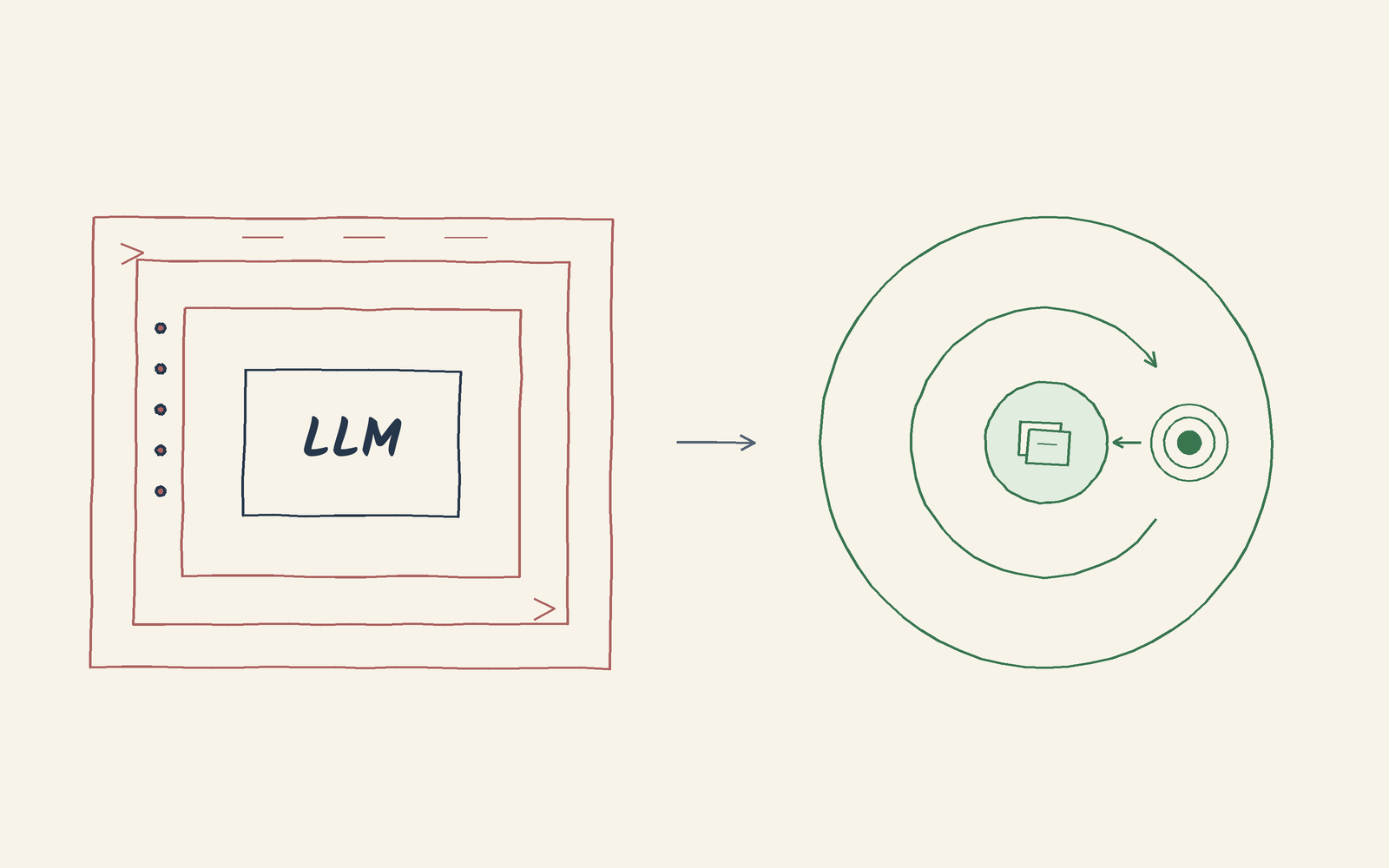
The recent release of GPT-6.1 Terra marks a major leap in autonomous computer use, scoring 74.2% on OSWorld 2.1 and 60% on Agents’ Last Exam. Such results suggest a problem nearing its solution.
Yet beneath the race for higher benchmark scores lies a familiar American philosophy: throw enough compute at a problem, and the results will follow. Terra may be an efficient model, but an efficient model does not necessarily make an efficient agent. Computer use isn't just another task for a language model. It's a fundamentally different problem, and deserves an architecture that reflects that.
I believe the next leap lies not in a smarter model, but in a more intentional architecture. I'll examine three fundamental inefficiencies in computer-use systems: sequential execution, monolithic inference, and growing interaction histories, then explore what an architecture designed to address them might look like.
Rethinking the Execution Loop
One often-overlooked cost of computer use is environment latency. Unlike text generation, where the model largely controls the pace of computation, computer-use agents must repeatedly wait for external systems: pages to load, interfaces to update, and actions to complete.
Modern agents typically follow an observe → reason → act → observe loop. In computer use, this sequential structure becomes particularly costly, with every action introducing another round of inference and environment latency. Instead of being limited primarily by prefill and decode, agents now face the combined latency of inference and environment transitions.
An alternative is asynchronous, speculative computation. While a page loads, an agent could anticipate likely next states, prepare candidate actions, and begin reasoning before receiving the next observation. By overlapping inference with environment latency, we can minimize time to first action (TTFA) after each transition, shifting the latency floor from the sum of both delays toward their maximum. The result is a faster workflow, limited increasingly by the environment itself rather than the agent waiting on it.
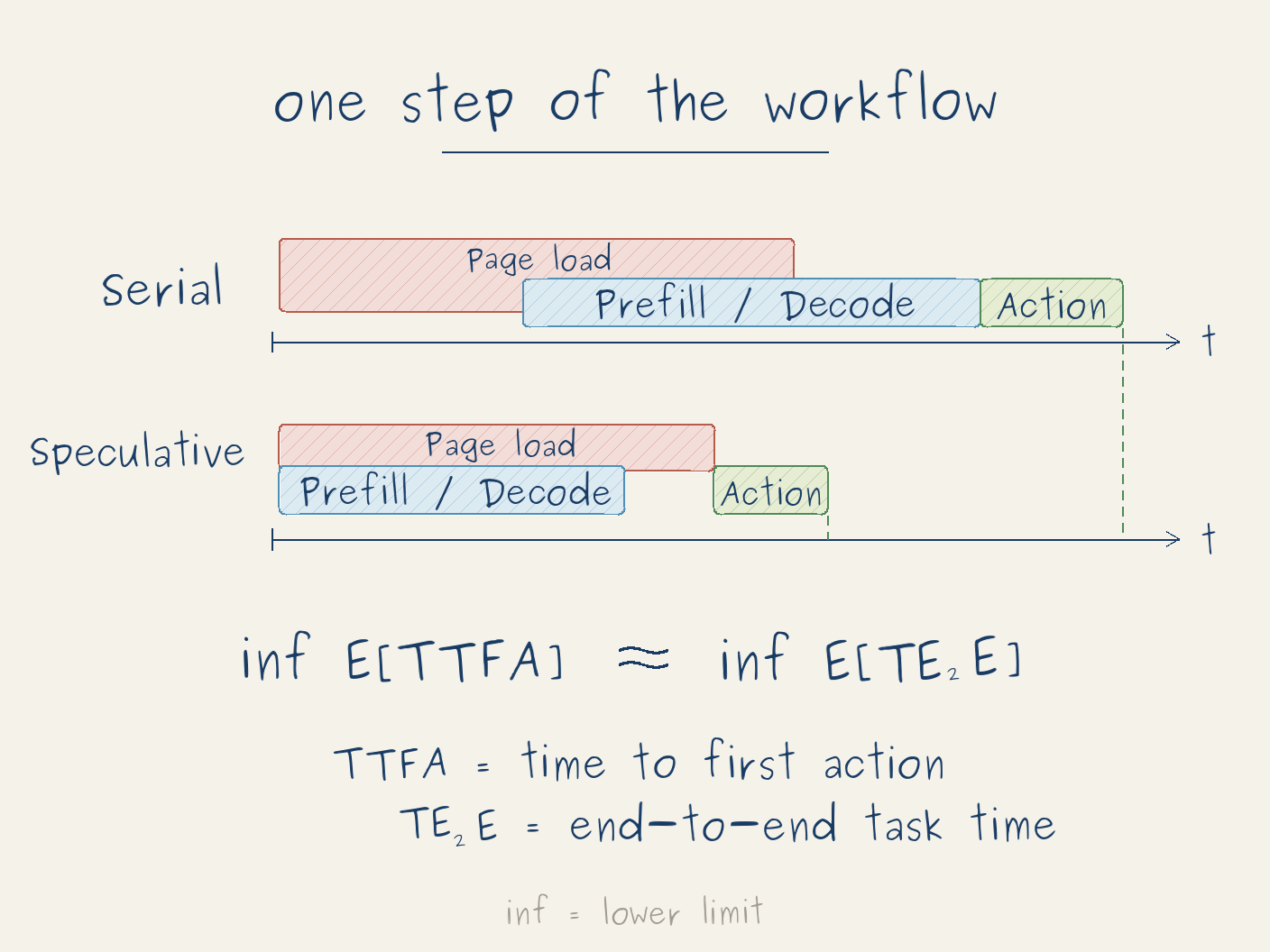
Successful speculation reduces post-load TTFA toward verification and dispatch overhead, bringing end-to-end latency closer to the environment-latency floor.
These ideas aren't entirely hypothetical. Speculative Actions demonstrates the potential of speculative agent execution, while Agent JIT Compilation shows how compiling and scheduling web tasks can dramatically reduce latency. TVCACHE explores a related opportunity during agent RL post-training: avoiding redundant interactions with the environment. Together, they suggest something broader: the execution loop itself is an opportunity for optimization, not just the model running inside it.
This hypothesis is only strengthened by the nature of web interfaces. Ask any good UI/UX designer what makes an interface successful, and you'll hear the same thing: “It's intuitive.” When someone clicks "Submit Order," they expect a confirmation page. When they click "Back," they expect to go back. The internet is designed around predictable interactions.
Now, not every action perfectly predicts the next one. But that's the nature of speculation: it's an educated guess.
More broadly, this suggests that computer use shouldn't be treated as a sequence of isolated inference calls, but as a continuous process in which reasoning and execution overlap. And if the next action is already predictable, that raises another question: why are we treating every action like a problem that demands frontier-level intelligence?
The Cost of Monolithic Inference
Many computer-use agents follow what I'd call a monolithic inference loop. Although reasoning budgets can adapt, a simple click and a complex planning problem still pass through essentially the same computational machinery. The problem isn't just how much a model thinks, but why execution must wait for deeper reasoning that could happen in parallel.
Computer use makes this inefficiency particularly apparent. A difficult workflow can contain many simple actions. Understanding the goal and choosing a path may require deep reasoning, but executing an established path? Rarely.
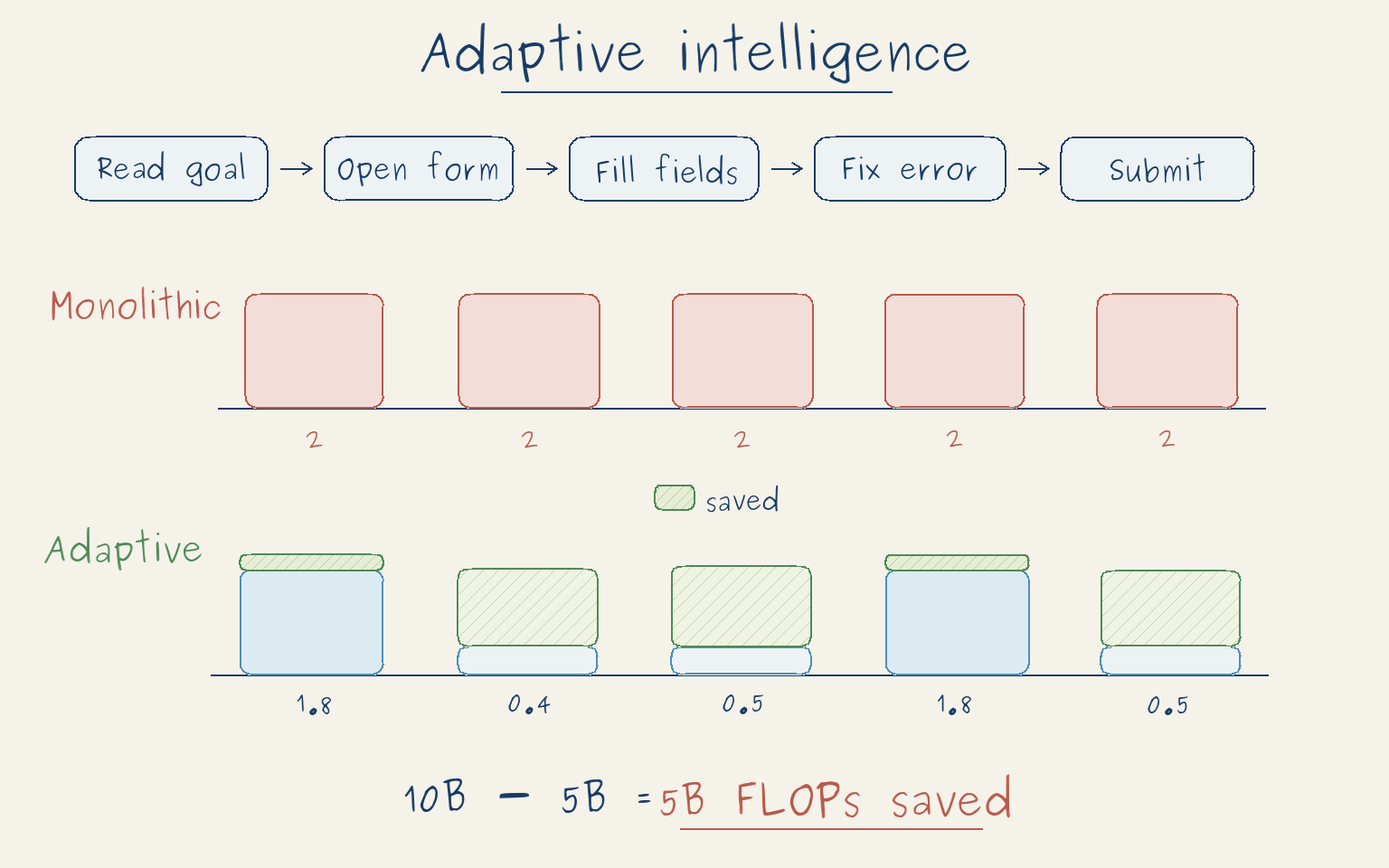
Monolithic inference applies the same underlying model to every action, while adaptive execution allocates less compute to predictable steps and deeper reasoning to difficult decisions.
Simply shrinking the model risks sacrificing capability where it's actually needed. There’s already research on when to think fast and when to think slow. I envision an integrated model with a lightweight execution path and a deeper reasoning path running concurrently, communicating through learned compact guidance. Computer use is a natural fit: low-latency execution must remain coordinated with ongoing planning and reasoning.
This architecture draws inspiration from dual-process theory in psychology, which distinguishes two modes of cognition. Intuition handles the immediate, while deliberate thought operates in the background, shaping what comes next. While a crude oversimplification of human cognition, this theory offers a useful conceptual framework for efficient AI systems: intelligence should guide execution without becoming its bottleneck.
Reducing the compute required for each action only solves part of the problem. A faster executor still wastes time if it must reconstruct its progress after every click. The final inefficiency isn't how much the model thinks, but how much it must remember.
Memory Without the Transcript
Imagine asking someone to complete a spreadsheet, but before every edit, making them read a log of everything they’ve done so far to figure out where they are.
This is the burden we place on computer-use agents that rely on interaction history instead of explicit state. Each model turn can require expensive computation to reconstruct progress from an expanding context window of screenshots, reasoning, and tool calls.
State trumps history for goal-based agents. Computer use offers a natural anchor for this state: the current page, form, or dialog. Each observation can update a compact latent representation of the interface, task progress, and goals, without requiring the agent to reconstruct its interaction history. Does this constrain the architecture to individual tasks and goals? Yes, deliberately so. The intent is not another general-purpose agent, but a specialized system optimized for speed and effective execution.
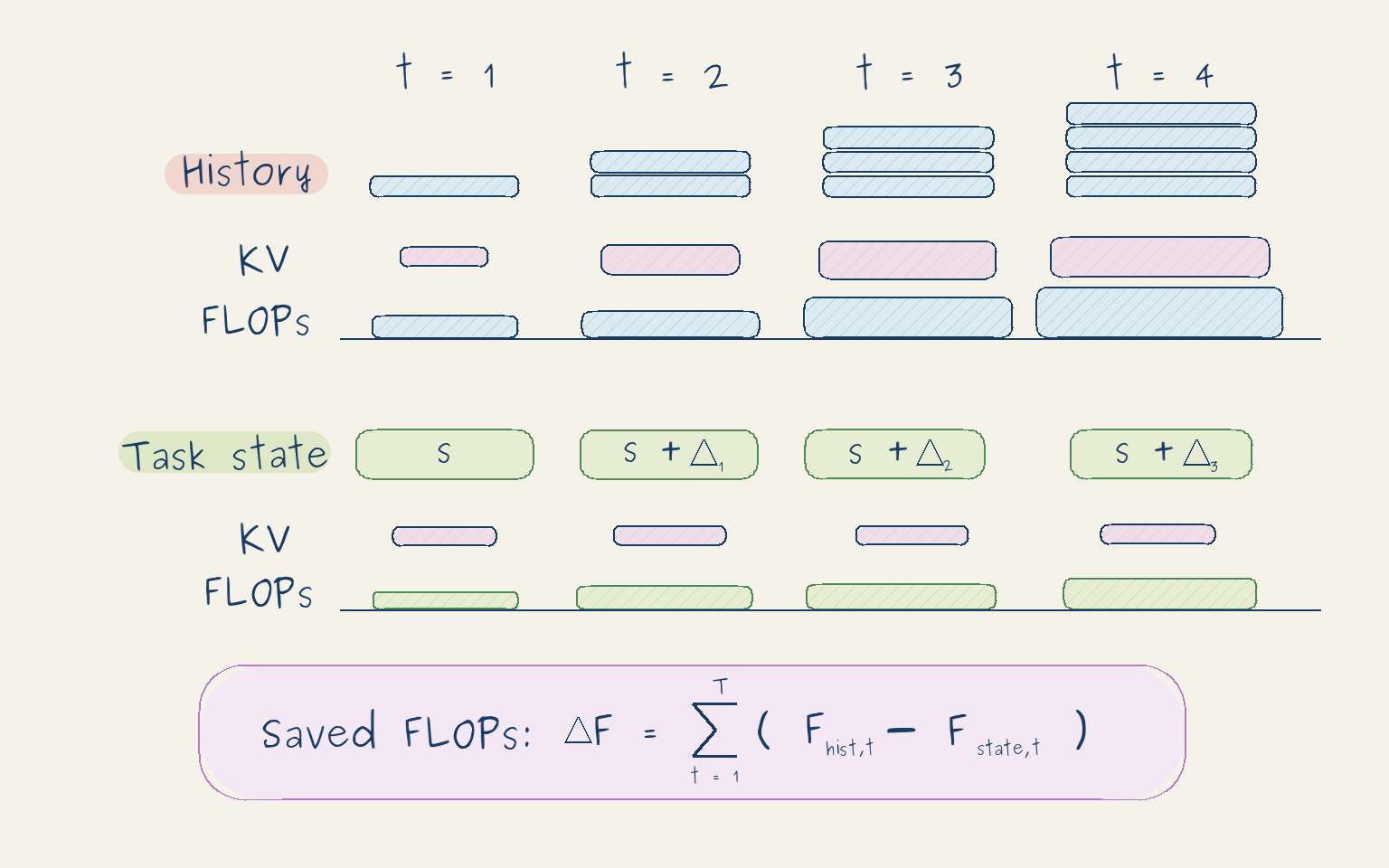
As interaction history grows, so can KV-cache memory and per-action inference costs. Maintaining a bounded task state avoids accumulating this history-related overhead.
Recurrence offers a natural solution: update what the model knows instead of reconstructing it. Recurrent memory research demonstrates that models can process longer sequences while keeping compute growth linear. Computer use presents a similar opportunity. “Save clicked” becomes “save confirmed.” Updating a compact latent state takes far less computation than repeatedly reasoning over an ever-growing history.
What comes after smarter models?
High benchmark scores tell us what computer-use agents are capable of, but not about the cost of putting that capability to work. As agents tackle longer, more complex workflows, these architectural inefficiencies become increasingly difficult to ignore.
We've become remarkably good at building models that can use computers. But building an efficient agent demands more than putting a powerful model inside an execution loop. I believe the next frontier isn't simply more intelligence, but making better use of what we already have. The future of computer use is architectural, not computational.
I'm interested in turning these ideas into a working system. If you're researching in this space or interested in helping build and train such a model, I'd love to collaborate. You can find the research proposal (PDF), or reach me at jdkrasnick@gmail.com.